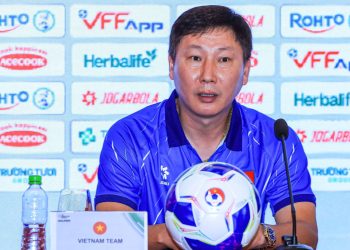














Laos head coach Ha Hyeok-jun believes the growing trend of fielding players of mixed or foreign heritage is not exclusive to Malaysia but is spreading rapidly across Southeast Asia.
His remarks came in the wake of the FIFA disciplinary ruling against seven Malaysian heritage players over alleged documentation irregularities, a case that has sparked widespread discussion on the naturalisation policies within ASEAN football.
“As everyone knows, Laos lost 0–3 to Malaysia in our previous match. There were many lessons to be learned, and we’ve analysed the mistakes. We’ve learned a lot from that game and hope to show improvement tomorrow,” said Ha during the pre-match press conference.
“Our players are in good condition and ready for the next match.”
The 42-year-old South Korean coach contrasted Southeast Asia’s approach with that of East Asian nations like Japan and South Korea, who, he said, have refrained from naturalising players for their national teams due to long-term considerations.
“Based on what I know, countries like Korea and Japan have never used naturalised players, and there are reasons for that,” Ha explained.
“We understand the short-term advantages — it can quickly improve a team’s quality — but there are also consequences. That’s why we don’t think about doing the same and prefer to focus on our performance.”
Ha’s comments underline a philosophical divide in Asian football — between teams relying on heritage or naturalised talent for instant impact and those investing in local player development and long-term sustainability.
The Laos coach also acknowledged that Malaysia and Indonesia are leading examples of this growing regional trend.
“There’s definitely a trend across Southeast Asia right now — not just in Malaysia and Indonesia — where countries are bringing in players of heritage, and sometimes even those without heritage links, to represent national teams,” he noted.
Ha’s pragmatic remarks come amid ongoing debate about the ethics, identity, and development implications of naturalisation in ASEAN football, especially after FIFA’s decision against Malaysia’s seven “Malaysian Abroad” players over document inconsistencies.
While the issue continues to dominate headlines, Ha remains focused on preparing his young Laos squad for their upcoming AFC Asian Cup 2027 Qualifiers fixture.
“Our priority is the match ahead. We’ve prepared the players to give their best and to represent Laos with pride,” he concluded.
The Laos national team will face Malaysia once again in their next qualifying fixture, hoping to rebound from their earlier 0–3 defeat and showcase their growth against one of the region’s strongest sides.
Credit Photo : FAM